
The Hidden Infrastructure Crisis in Companion Feline Care
Emotional, Economic, and Clinical Pressures in the Post-Pandemic Cat Ownership Era
Companion feline care is undergoing a profound structural transformation that remains poorly recognized by the public, veterinary systems, and even portions of the pet care industry itself. Over the past two decades, and particularly following the COVID-19 pandemic, companion cat ownership has expanded dramatically while the complexity of feline care needs has intensified.
The modern indoor companion cat no longer fits the outdated cultural narrative of being “easy,” “low maintenance,” or naturally self-sustaining. Today’s cats increasingly function as emotionally central, medically complex, highly dependent companions requiring sophisticated behavioral, environmental, medical, and grooming support across extended lifespans.

The Modern Companion Cat Is a Different Animal
Historically, many cats functioned primarily as outdoor territorial animals, barn cats, or semi-feral rodent control companions operating within environmental systems that naturally supported movement, territorial expression, coat abrasion, and seasonal adaptation.
The modern indoor companion cat represents a fundamentally different caregiving structure. Today’s cats are increasingly:
The Pandemic Cat Boom and the Escalation of Care Complexity
The COVID-19 pandemic accelerated cat acquisition across North America at an unprecedented scale. During periods of isolation, grief, instability, and remote work transition, millions of individuals adopted companion animals for emotional regulation and connection.
This expansion occurred simultaneously with veterinary workforce shortages, increasing burnout among animal care workers, housing instability, inflation, and declining appointment availability across care systems.
Frontline feline professionals increasingly began observing:
- Severe matting and coat casing
- Obesity-related grooming impairment
- Embedded nails and paw collapse
- Mobility restriction and arthritic decline
- Stress intolerance and behavioral escalation
- Advanced geriatric deterioration
- Delayed-care presentations arriving in crisis
Trauma-Informed Positional Support Systems
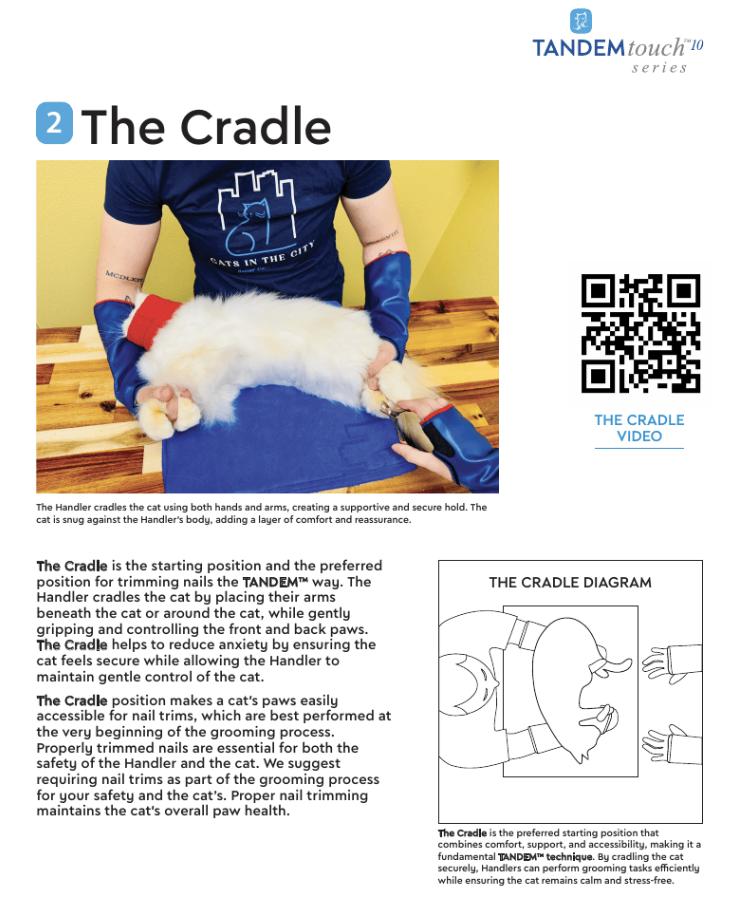
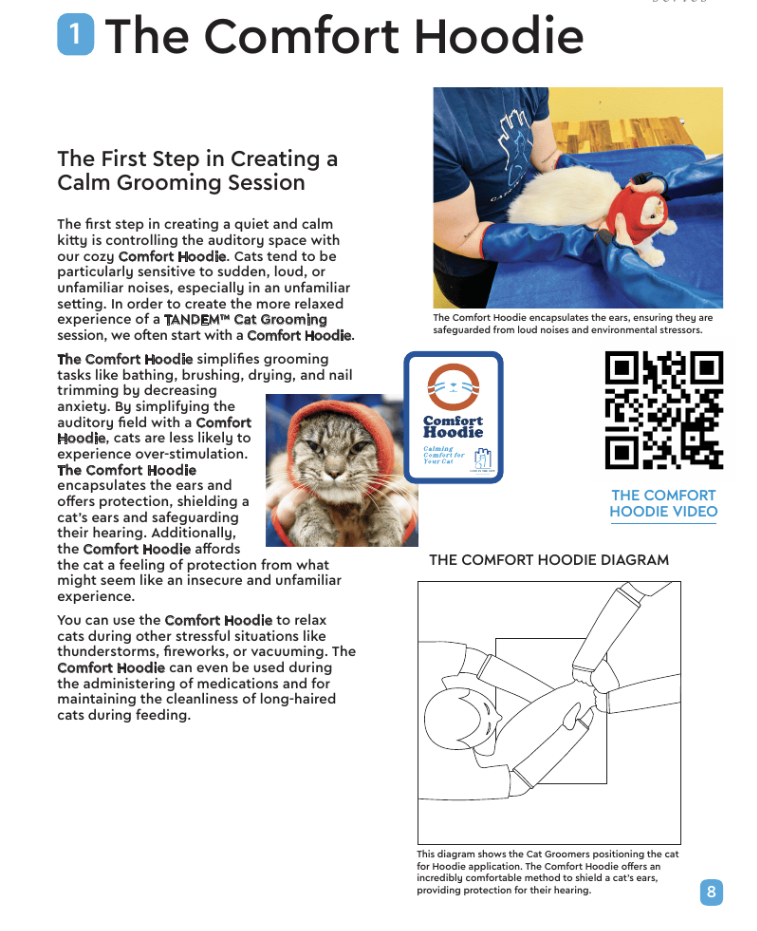
High-risk feline grooming often depends less on force and more on carefully engineered positioning systems that reduce stress load, support body stability, and minimize escalation. The TANDEM Cat® framework utilizes structured handling positions designed around feline behavioral tendencies, sensory regulation, and procedural tolerance.


Advanced Matting Is Not Cosmetic
Advanced feline matting is widely misunderstood as a cosmetic issue. In reality, restrictive coat burden can impair mobility, thermoregulation, elimination posture, airflow, sleep quality, and behavioral regulation.
In severe cases, interconnected “chaining” patterns form across joints and body planes, creating continuous traction on fragile skin and restricting normal movement. Elderly cats may develop tissue-paper dermis highly vulnerable to tearing during aggressive coat removal.
Under these conditions, grooming transitions from cosmetic maintenance into a form of clinical decompression care.
Safe intervention may require:
- Staged coat liberation
- Strategic coat preservation
- Behavioral pacing
- Sedation coordination
- Multiple handlers
- Shortened sessions
- Environmental modification
- Deferred cosmetic completion
Pilikia: Medically Complex Persian Grooming Under Cardiovascular Risk

Clinical grooming case of Pilikia, an 11-year-old Persian presenting with significant medical considerations including a grade 3/6 heart murmur, luxating patella, and overall increased handling sensitivity.
Pre-appointment support included gabapentin administration to reduce stress load and improve tolerance. Due to cardiovascular and orthopedic risk factors, grooming required a highly controlled, low-intensity approach focused on minimizing exertion and preventing physiological escalation.
Care was performed using the TANDEM Cat® method, emphasizing gentle restraint alternatives, positional support, and continuous monitoring of breathing, tension, and responsiveness.
Services included light de-shedding, targeted mat relief, tapered face grooming, mane and bib maintenance, and a sanitary trim while intentionally avoiding unnecessary procedures such as tail shaving to reduce total physiological load.
Pilikia remained supported throughout the session, demonstrating that medically complex, higher-risk cats can safely receive grooming when care is intentionally scaled, closely observed, and structured around stability rather than procedural completion.
Isis: Senior Grooming Under Multisystem Medical Burden

Clinical grooming case of Isis, a 12-year-old senior cat with chronic kidney disease (CKD), asthma, arthritis, mobility instability, and sensitive skin.
Presentation required a highly controlled, low-intensity grooming approach to prevent physiological stress and maintain stability throughout care.
Grooming was performed using the TANDEM Cat® method, prioritizing slow pacing, positional support, and continuous monitoring of tolerance.
Services included de-shedding, full belly sanitary shaving, gentle bathing with low-irritation products, and hygiene maintenance while carefully observing for skin reactivity or breakdown.
Handling was adjusted continuously in real time to accommodate joint discomfort, balance limitations, respiratory sensitivity, and age-related fatigue.
Isis remained stable during the process, demonstrating that medically complex senior cats can safely receive necessary grooming when care is structured around body awareness, reduced procedural load, and trauma-informed handling.
The Invisible Infrastructure of High-Skill Feline Care
Most guardians dramatically underestimate the operational infrastructure required to safely support high-needs cats.
Specialized feline care systems frequently depend upon:
Yet broader culture continues categorizing these services as optional “pet grooming” rather than recognizing them as specialized caregiving infrastructure adjacent to veterinary support systems.
The Psychological Weight of Companion Cat Care
Cats increasingly occupy psychologically central roles within households, particularly among isolated individuals, aging adults, trauma survivors, neurodivergent populations, child-free households, and people experiencing grief or emotional instability.
As a result, deterioration in a cat’s condition may trigger profound emotional reactions including guilt, shame, panic, denial, grief, and defensive projection.
Care interactions surrounding severe matting or delayed intervention therefore become emotionally charged far beyond the immediate grooming procedure itself.
Preventive Grooming as Welfare Infrastructure
Preventive maintenance models may represent one of the most important future directions in companion feline welfare.
Rather than framing grooming as episodic cosmetic intervention, continuity-care systems distribute support across time through:
These systems may substantially reduce catastrophic matting, emergency shave-downs, restraint escalation, caregiver shame cycles, and crisis-based grooming interactions.
Conclusion
The modern companion feline care ecosystem is undergoing rapid transformation while public understanding remains anchored to outdated assumptions about cats as simple, low-maintenance pets.
Today’s indoor companion cats increasingly function as emotionally central, medically complex, long-lived dependents requiring substantial infrastructure to support humane quality of life across aging and illness.
Without broader recognition of the true labor burden of feline care, the emotional realities of companion guardianship, and the infrastructure required for preventive maintenance, conflict between guardians and care providers will likely continue to intensify.
The future of feline welfare may depend not only upon advances in veterinary medicine, but upon society’s willingness to recognize grooming, behavioral support, boarding, and preventive maintenance as essential components of companion animal health infrastructure rather than optional cosmetic luxuries.
It Takes Two to TANDEM™
Are you ready to practice TANDEM Cat® Care? Request a full evaluation and consultation.


